Make sense of what is happening.
Bring relevant perspectives, evidence, experience, strengths, tensions, and emerging signals into view.
 Start a conversation
Organizations face a continuing stream of new technologies, leadership changes, shifting expectations, emerging opportunities, and unexpected disruptions.
The goal is not to predict every change. It is to become better at navigating change when it comes.
The immediate challenge matters, but it is only part of the picture. We begin by understanding what people care about, what is already working, what the organization knows, and where the work is getting stuck. That allows the work to build from existing strengths and capacity while addressing what needs to change.
Bring relevant perspectives, evidence, experience, strengths, tensions, and emerging signals into view.
Clarify priorities, decision-making, ownership, dependencies, and resources so important work can move across boundaries.
Build reflection, feedback, and knowledge-sharing into the work so experience improves future decisions and practice.
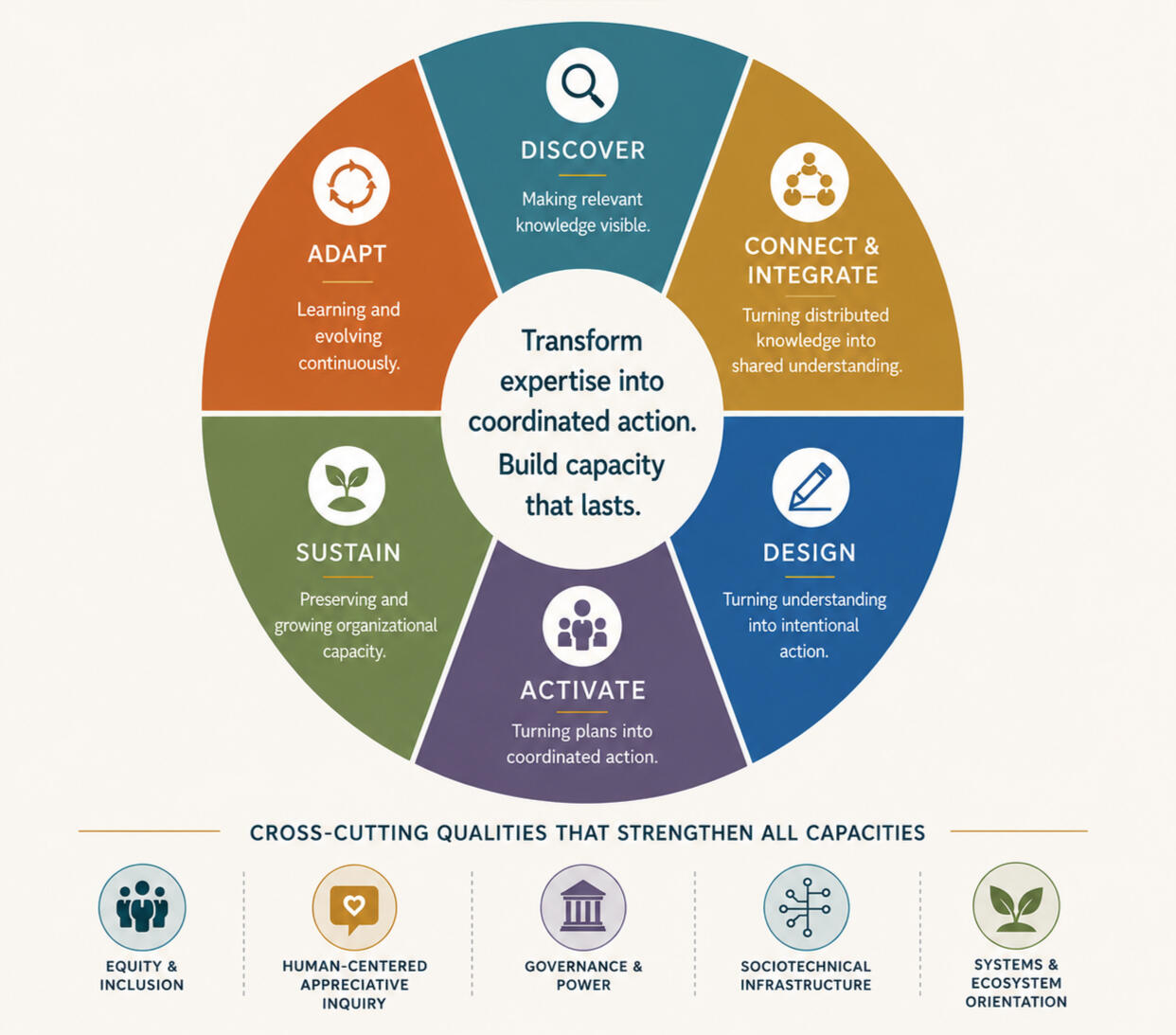
Through these practices, Confluence Network helps strengthen six organizational capacities that matter again and again:
Find the knowledge, perspectives, strengths, risks, and signals that matter.
Bring together scattered knowledge and experience so the organization can see a fuller picture.
Shape responses that fit the situation, the people involved, and the conditions around them.
Turn choices into coordinated action with clearer ownership, resources, and decision-making.
Keep useful practices, relationships, and knowledge from disappearing when a project ends or people move on.
Use feedback and changing conditions to adjust what the organization does next.
The model also asks whose knowledge counts, who can participate and influence decisions, how authority is distributed, what technology enables or gets in the way, and how the larger system shapes the work.
We are developing the Confluence Capacity Assessment to help organizations see recurring strengths, uneven capacity, and differences in perspective. We are currently seeking a small number of higher education organizations and units interested in becoming early pilot partners.
Learn about the pilot opportunity →No two organizations experience the same challenge in the same way. We draw on a wide range of structured tools and methods—from interviews and assessments to mapping, convenings, design sessions, governance work, and learning practices. We choose and adapt them based on your context, the people involved, and what the work requires.
What stays consistent is our commitment to bringing relevant perspectives into view, making choices and ownership clearer, building learning into the work, and keeping interpretation and decisions with the organization.
See what an engagement can look like →If the work is exposing gaps in shared understanding, decision-making, coordination, or learning, Confluence Network can help you see what is happening and decide where to begin.
Tell us what you are working through